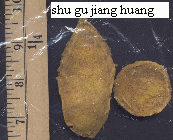
| | shu gu jiang huang 束骨薑黃 (in English and Chinese 中英文) da jiang huang 大薑黃 by: Joe Hing kwok Chu compared with inches 與英寸比較 Pharmaceutical name: 英文藥名: | Rhizoma Curcuma xanthorrhizae | Biological name: 拉丁學名: | Curcuma xanthorrhiza Roxb. Curcuma zanthorrhiza Roxb., nom. illeg. | Pron. in Cantonese: 粵音﹕ | daai6 goeng1 wong4 | Common Name: 普通名稱﹕ | English: giant curcuma, false turmeric, Indonesian: temu lawak, temulawak, Malay: temulawas Tagalog: dilaw, dilao | Distribution: 產地﹕ | India, southern part of China, Africa and south east Asia 印度﹐中國南部﹐非洲﹐東南亞。 | Properties (characteristics)﹕ 性味﹕ | acrid, bitter, aromatic, slightly sweet 辛﹐苦﹐香﹐略甜。 | Channels (meridians) entered: 歸經﹕ | liver, spleen and lung 肝﹐脾﹐肺經。 | Actions & Indications: 主治: | Uses in: | 用途﹕ | cholagogue (promotes bile secretion) [2] | 利膽劑 (促進膽汁分泌) | analgesics | 止痛 | anti-rheumatoid arthritis and muscular pains | 治風濕﹐筋肉疼痛 | antipyretic | 退熱 | anti-hepatotoxic | 抗肝毒 | liver problems,[3] jaundice and gallstones | 治肝病﹐黃膽﹐膽石 | lactagogues (promoting the flow of breast milk) | 催乳 | skin diseases | 皮膚病 | to improve contraction of uterus in postpartum | 產後幫助子宮收縮 | anti inflammation in postpartum uterine bleeding. | 如産後子宫出血,作消炎用 | antispasmodic, eliminating cramps | 止抽筋 | anti-dysmenorrhea | 調經 | inflammation of the rectum and hemorrhoids | 直腸炎﹐痔瘡 | inflammation of the mouth | 口腔發炎 | bloody diarrhea | 血痢 | dysentery | 痢疾 | stomach disorders caused by wind-cold | 腹受風寒 | children's cough and fever | 小兒發熱﹐咳嗽 | constipation | 便秘 | general tonics | 作為補藥用 | diabetes | 糖尿病 | anti-itching | 止癢 | yeast infection, leucorrhoea, and rid of gastric gas | 黴菌感染﹐白帶﹐腸道氣脹 |
| Medical Functions﹕ 藥理: | Medical Functions﹕ anti inflammatory,[13] anti coagulation of blood cells, cholagogues (promoting bile secretion), lactagogues (promoting the flow of breast milk) glucose lowering activity in diabetic rats antifungal antibacterial: xanthorrizol can inhibit Staphylococcus Aureus (SA) and Methicillin-Resistant Staphylococcus Aureus (MRSA) Inhibits foodborne pathogens. Bacillus cereus, Clostridium perfringens, Listeria monocytogenes, Staphylococcus aureus, Salmonella Typhimurium, and Vibrio parahaemolyticus protects liver, lowering AST and ALT [4}[9] can cause contraction of the uterus. anti oxidant [4} anti tumor [5} lowers the concentrations of serum triglycerides and phospholipids, and liver cholesterol, and increased serum HDL-cholesterol and Apolipoprotein A-1 (Apo A-1) [1] [5] inhibiting beta-amyloid (Abeta) in Alzheimer's patients inhibits lymphocytic cells of chronic lymphocytic leukemia inhibits fibrosis of lung tissues anti-metastatic potential in experimental mouse lung metastasis model [6] the methanol extract of this herb possesses cancer chemopreventive potential.[7] activating T and B cell-mediated immune functions.[8] combined xanthorrhizol-curcumin exhibits synergistic growth inhibitory activity via apoptosis induction in human breast cancer cells MDA-MB-231. [10] Curcuma xanthorrhiza ethanolic extract showed peripheral and central antinociceptive activity associated with neurogenic pain [11]
藥理: 抗發炎[13] 抗血細胞凝集 利膽作用 催乳汁 降低血糖 (患有糖尿病之大鼠) 抗黴菌 抗菌:束骨薑黃素可以抑制金黃色葡萄球菌(SA)和耐甲氧西林金黃色葡萄球菌(MRSA) 抑制食源性致病菌:蠟樣芽胞桿菌,產氣莢膜梭菌,李斯特菌,金黃色葡萄球菌,沙門氏菌,副溶血性弧菌 保護肝臟﹐降低 谷氨酸天氨酸轉氨脢 AST 與 谷丙轉氨脢 ALT[4] [9] 使子宮收縮 抗氧化 抗癌 降低血清中三酸甘油脂﹐ 磷脂﹐膽固醇﹐增高血清中高密度膽固醇 與轉體蛋白A-1 (Apo A-1) 抑制導致阿耳茨海默氏病的記憶衰退的乙型-澱 粉樣蛋白 (Abeta)。.。 抑制慢性淋巴球白血病之淋巴细胞 抑制肺囊腫之囊腫纖維形成 抑制小鼠肺癌之轉移[6] 束骨薑黃的甲醇提取物對防癌有效[7] 激.活免疫系統的T細胞與B細胞。[8] 束骨薑黃醇加薑黃素可致使乳腺癌細胞(MDA-MB-231)自動自殺毀滅。[10] 束骨薑黃乙醇提取物顯示對週邊和中樞鎮痛活性
與神經痛的止痛有效。[11]
| Chemical ingredients: 化學成份: | volatile oil (6-11%): (a) 1-cyclo-isoprene myrcene (up to 85%); (b) an aromatic sesquiterpene phenol , xanthorrhizol, (up to. 20%) (not found in jiang huang (C. longa)), camphor, isofurano - germacrone, cineole, borneol . curcuminoids : curcumin 62% and demethoxycurcumin 38%. starch (30-40%)
揮發油(6-11%):(a)1-環-異戊 二烯月桂烯(高達 85%); (b)芳 香倍半萜烯酚,束骨薑黃素(高 達20%)(在薑黃中沒發現存在),樟 腦,異氟烷 - 牻牛兒酮 (吉馬酮), 按油精,冰 片.。 薑黃素:薑黃素62%,脫甲氧基薑黃素38%。 澱粉(30-40%)。
| Dosage﹕ 劑量: | fresh root: 3 ~ 9 grams, graded, Dried root: 1 ~ 5 grams Boil briefly to avoid losing the essential oil. Take before meals for improving digestion. 鮮品﹕ 3~9 克 (切碎) 乾藥材﹕1 ~ 5 克。 不可久煎以免損失揮發油。飯前服用﹐以幫助消化。 | Samples of formulae﹕ 藥方舉例: | For pimples: shu gu jiang huang 3 g, fresh tamarind 10 g. Put in a pre warmed cup and add boiling water. Cover and let stand for 10 minutes. Use as tea every morning. Eat plenty of vegetable and fruit and avoid fatty food. 治粉刺﹕束 骨薑黃3克﹐鮮羅望子10克﹐加入沸水中。收火。加蓋。置之10分鐘。每天早上當茶喝 。吃多量蔬菜﹐避免肥油。 More to upload. | Modern Research: | Xanthorrhizol, an active ingredient, has an anti-metastatic potential in experimental mouse lung metastasis model [6]本品有效成份之一,束骨薑黃素,有對 抗試驗小鼠肺癌擴散之潛能。 | Cautions﹕ 禁忌﹕ | Do not use during pregnancy; (may cause uterus contraction) if there is a bile duct obstruction. (it can increase bile secretion and may create inflammation) with gallbladder disease as it will increase the flow of bile, creating a possible flare-up. on those on blood-thinning medications (it has blood thinning effect). It possesses a strong anti-coagulation effect. So this herb may not suitable to use with anti-coagulants like Aspirin, heparin or warfarin (Athrombin-K, Carfin, Coumadin, Panwarfin, Sofarin, Warfilone).
Long- term large quantity usage may produce stomach ulcer. 如有以 下情 形﹐不可用﹕ 懷孕期 間 (因能引起子宮收縮) 膽管阻 塞(因為能增加膽汁﹐可能引起發炎) 膽囊毛 病 用抗 凝血性的化合物 。束骨薑黃 本身已有抗凝血作 用 。不應與抑制 凝血西 药如阿 斯匹林 Aspirin (乙醯水楊酸) 華 法林或肝素warfarin (Athrombin-K, Carfin, Coumadin, Panwarfin, Sofarin, Warfilone),heparin 等同用。
長期大量服 用﹐可能引起胃潰瘍。 處方時最好 寫束骨薑黃。如寫大薑黃,藥店 常用較大片的薑黃代替。 |
Note: The cholagogue effect of shu gu jiang huang is the synergistic effect of curcumin and the essential oil of the herb. To preserve the evaporating oil, do not overheat or over- cook the herb. Compared to jiang huang (Curcuma Longa.; Curcuma domestica) Curcuma xanthorrhiza is a better choice. Jiang huang contains the ingredient of bisdemethoxycurcumin of 29%, and shu gu jiang huang does not contain any. It is the bisdemethoxycurcumin that can decrease bile flow. The ingredient xanthorrizol (a phenolic sesquiterpene) that inhibits Staphylococcus Aureus (SA) and Methicillin-Resistant Staphylococcus Aureus (MRSA) is not found in jiang huang (Curcuma longa). [1]Food Chem Toxicol. 1993 Mar;31(3):213-8. Yasni S, Imaizumi K, Nakamura M, Aimoto J, Sugano M. [2]Sinambela JM. Fitoterapi, fitostandar dan curcumin. Proceeding of National Symposium on Curcumin. Pajajaran University Research Institute, Bandung. pp. 150-55.[3][5]Hadi S. Manfaat curcumin ditinjau dari segi kedokteran. Proceeding of National Symposium on Curcumin. Pajajaran University Research Institute, Bandung. pp. 139-44. [4}Kiso Y, Y Suzuki, N Watanabe. et al. 1983. Antihepatotoxic principles of Curcuma longa rhizomes. Planta Medica; 49:185-7. 9. [5]Vimala S et al. British Journal of Cancer 80:110-6, 1999 Apr [6] Biochem Biophys Res Commun. 2005 Jan 7;326(1):210-7. [7] Phytother Res. 2008 May;22(5):695-8. [8] J Nutr Sci Vitaminol (Tokyo). 1993 Aug;39(4):345-54. [9] Am J Chin Med. 1995;23(3-4):243-54. [10] doi: 10.1186/1475-2867-9-1. [11] Molecules 2010, 15, 2025-2934 [12] J Food Prot. 2008 Sep;71(9):1926-30. [13] Int J Biochem Cell Biol. 2009; 41(1): 40–59. Reference. Lukman AH, T. Silitonga. Curcumin, khasiat dan aneka kegunaannya. Proceeding of National Symposium on Curcumin. Pajajaran University Research Institute, Bandung. pp. 220-3.
註﹕ 束骨薑黃 之助分泌膽汁之作用是其揮發油薑黃素 聯合其他成份引起的。所以此藥不宜久煎以免揮發油損失。薑 黃含有 29% 去二甲氧基姜黄素 (bisdemethoxycurcumin)。 此成 份能防礙膽汁之分泌而束骨薑黃不含此化合物質。 故比起薑黃﹐束骨薑黃應是較好的選 擇。 束骨薑黃 化學成份之一﹐酚醛樹脂倍半帖類 (phenolic sesquiterpene)之 束骨薑黃素(xanthorrizol) 可抑制金黃葡萄球菌與已產生抗甲氧西林 (Methicillin) 藥性之金黃葡萄球菌。薑 黃或鬱金不含此成份。 Protective and therapeutic effects of Curcuma xanthorrhiza on hepatotoxin-induced liver damage Lin SC; Lin CC; Lin YH; Supriyatna S; Teng CW Department of Pharmacology, Taipei Medical College, Taiwan. Am J Chin Med, 23(3-4):243-54 1995 Reporting in the Dec. 7, 2004, online edition of the Journal of Biological Chemistry, the research team also determined curcumin is more effective in inhibiting formation of the protein fragments than many other drugs being tested as Alzheimer's treatments. 澱粉狀蛋白斑(amyloid plaque)属于 蛋白粉末不正常 的集結,叫做b-澱粉狀 蛋白(b-amyloid) ,是導致阿耳茨海默氏病的記憶衰退 的元凶。
美國洛山基加里福尼亞大學最近通過老鼠所作的研究實驗結果表明,薑黄不僅能防止那些患有老化性腦部疾病病者積累病斑,而且可以阻止病斑在第一阶段 的發展。此项研 究的結果發表在生物化學刊物上。
Links (more to upload): http://www.ncbi.nlm.nih.gov/entrez/query.fcgi?cmd=Retrieve&db=PubMed&list_uids=8571920&dopt=Abstract http://www.ncbi.nlm.nih.gov/entrez/query.fcgi?cmd=Retrieve&db=PubMed&list_uids=8473006&dopt=Abstract Sponsors' Ads by Google 以下為谷歌 所提供之廣告 |